
Primavera Gallery is proud to annouce the opening of our new exhibition, entitled ART DECO REVISITED, which will run from November 12, 2009 through February 28, 2010. We will be showing beautiful examples of furniture, glass, ceramics, metalwork, sculpture and works on paper that showcase various aspects of the Art Deco movement, as well as a few selected examples of later pieces that were influenced by Art Deco.
We were motivated to put together this exhibition not only because Art Deco has been an important focus of our gallery for the past 40 years, but also because there is so little coming onto the market now, and with the recent focus on contemporary design, we feel that young collectors, who do not have a great deal of opportunity to see fine Art Deco pieces, may be overlooking this great design period.

Primavera Gallery participated in the highly prestigious International Fine Art and Antiques Dealer's Show that was held at the Park Avenue Armory from October 16-22, 2009. If you visited us then you must have seen our beautiful Pierre Traverse "Bathing Woman" sculpture, the fabulous Phillip Lloyd Powell carved walnut sideboard and the magnificent ceramics by Jean Mayodon. However, in case you missed us, here as some pictures of our booth.
Audrey Friedman visited Let 's Talk Live!, on News Channel 8 in Washington D.C., on Friday, March 6th to discuss the Washington D.C. Spring Antiques Show. In the process she gave Natasha and Doug a lesson in antique jewelry appreciation.
Primavera Gallery is a generous lender to museums world-wide. You can currently see pieces from our collection at the following places:
“Small Offering of Refreshment” (1993) by Bruce Metcalf is on loan to The Miniature Worlds of Bruce Metcalf. Although it just closed at the Palo Alto Art Center in California and at the Mint Museum of Craft and Design in North Carolina it may be traveling to a city near you:
Bellevue Arts Museum, Bellevue, WA. (June 27-Oct. 18)
Fresno Art Museum, Fresno, CA (Nov. 10- Jan. 10, 2010)
Southwest School of Art & Craft, San Antonio, TX (Feb 11 Apr. 11, 2010)
Arkansas Arts Center, Little Rock, AK. (May 28-Aug. 22, 2010)
Racine Art Museum, Racine, WI. (Sep. 2010-Jan. 2011)
The Nature of Diamonds exhibition originated at the American Museum of Natural History in New York but now our glittering diamond French earrings (ca. 1880), Sculpted Head Brooch (ca. 1965) by Serafini and a Dandelion seed ball ring (ca. 1962) by Antonio Gie are on view at the following cities:
Houston Museum of Natural Sciences, Houston, TX (May 9, 2009-September 7, 2009)
The Field Museum, Chicago, IL (October 17, 2009-March 28, 2010).
We also have lent our jewelry to the following recently closed exhibitions:
Van Cleef& Arpels organized a beautiful exhibition, aptly titled "The Spirit of Beauty" at the Mori Arts Center Gallery in Tokyo (October 31, 2009-January 17, 2010). We lent two fabulous pieces of jewelry and while the exhibition has since closed, the website is still up and features the fabulous jewelry on exhibit: http://www.thespiritofbeauty-vancleef-arpels.com/en/
We loaned twenty-five rare and incredible pieces of jewelry to the Musee des Arts Decoratifs for their exhibition titled Bijoux Art Deco et Avant-Garde: Jean Despres et les Bijoutiers Modernes (March 18- May 31, 2009).
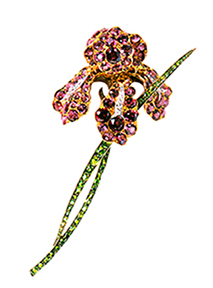
Artistic Luxury: Faberge, Tiffany, Lalique at the Fine Arts Museum of San Francisco from February 14- May 31, 2009. Did you see our exquisite pieces: Paulding Farnham for Tiffany & Co., “Scent Bottle” (ca. 1900), Marcus & Co., “Corsage Ornament” (ca. 1915), and Paulding Farnham for Tiffany & Co., “Iris Brooch” (ca. 1900-01)? Yes! That is OUR “Iris Brooch” on the cover of the exhibition catalogue.
Surreal Things: Surrealism and Design the groundbreaking exhibition from the Victoria and Albert Museum in London is traveling stateside. Don’t miss our jewelry by Salvador Dali (Ruby Lips!) and also his Leaf-hand box as well as a fabulous bracelet by Rene Boivin and Gio Ponti’s Golden Hand and Hand with Relief Motifs in a city near you.
Art Gallery of Ontario, Toronto, ON, Canada (May 9- September 19, 2009)
Primavera Gallery participated in two exciting antiques show in early 2009: PALM BEACH JEWELRY, ART & ANTIQUE SHOW (February 13-17, 2009 in Booth 600. Click on the link for more information http://www.palmbeachshow.com/) at the Palm Beach County Convention Center and also the inaugural D.C. SPRING ANTIQUES SHOW (March 6-9, 2009) at the Walter E. Washington Convention Center.
In case you forgot to visit us at the International Art + Design Fair, here is a sample of some of the things that you missed:

Primavera Gallery exhibited at The International Art + Design Fair (October 3-8, 2008 ) held at The Park Avenue Armory. http://www.haughton.com/

“MINERALOGY 101”, An exciting exhibition at Primavera Gallery.
From May 1 - 31, 2008 PRIMAVERA GALLERY will host a special exhibition and sale entitled MINERALOGY 101, featuring unique table lamps, furniture, objects and jewelry that incorporate striking mineral specimens into their design, with pieces by Ado Chale, Willy Daro, Andrew Grima and others.
Several years ago, on buying trips in Paris, we began seeing pieces designed in the late 1960’s and early 1970’s that used various minerals or petrified wood either as a primary design element, or incorporated into the body of a piece as a striking focal point. The French designers Jean-Charles Moreux and Bolette Natanson had used fossils in designs done in the 1930’s, but it took another 20 years for the idea to really catch on.
We were seeing wonderfully dramatic slabs of petrified wood and agate polished and mounted as “sculptures”, petrified wood specimens imbedded into table tops, and mineral and fossil specimens used with great effectiveness as lamp bases. We realized that this was a little-known stylistic element of mid-century interior design. The resulting pieces combine the unexpected, spontaneous and almost magical aspects of minerals – structured yet random, lyrical and poetic in their accidental beauty - with often stark, architectural mountings that are dramatic counterpoints to the irregularities of nature. Other designs incorporate the minerals in mountings that reflect and compliment the flow of colors and forms. Because of the spontaneous nature of minerals, each piece is a unique combination of design and “accident”.
We are especially pleased when we find pieces by the Belgian designer Ado Chale, such as the wonderful round lacquer and petrified wood coffee table and the dramatic table lamps in this show. Chale was a master at seamlessly incorporating minerals, many from his personal collection, into lamps and table tops.
The exhibition will also feature jewelry. Using minerals in jewelry is not necessarily a new concept, but using them in their “raw” form, bristling with crystals, was something new – an important element in American Studio jewelry beginning in the 1950’s, and also showing up in fine jewelry design. Among those with a talent for making jewelry using striking minerals was the Parisian designer Suzanne Belperron as well as the acclaimed British designer, Andrew Grima, a gifted master who also designed pieces for Princess Margaret.
Over the forty years we have been buying and selling jewelry and furniture, we have often been surprised by the ingenuity as well as the technique and craftsmanship of many designers. Whether the designer chose an architectural format or a decorative one, the ability to utilize minerals and other elements of nature in modern works of art captured the spontaneous nature of design during the decades after WWII.
We are delighted when we can familiarize our clients with unique designs they may not have seen before. When you see several of your favorite designers embracing entirely natural forms and a wide range of interesting minerals, it’s very satisfying to bring them together for a show. Above and below are just a small selection of the types of objects that we will exhibit.
Primavera Gallery participates yearly in the INTERNATIONAL ART + DESIGN FAIR at the Park Avenue Armory (October 3-8, 2008 in Booth D1 ) as well as the PALM BEACH JEWELRY, ART & ANTIQUE SHOW (February 13-17, 2009 in Booth 600) Click on the link for more information about the Palm Beach show. http://www.palmbeachshow.com/ . Please come and visit us!
|
|
Primavera Gallery at The International Art + Design Fair, October 2007. |

Primavera Gallery presented two highly acclaimed gallery exhibitions in the Fall 2007:

ANDRÉ THURET AND DAUM FRÈRES – TWO MASTERS OF FRENCH ART DECO GLASS
The acknowledged master of French Art Deco glass, and, arguably one of the most gifted and innovative glass artists of the 20th century was Maurice Marinot. His work inspired several other glass artists to experiment with his techniques, and two names emerge of great importance – André Thuret, a highly trained studio glass artist, and Paul Daum, grand-son of Jean –Louis Daum, who, with his brother Louis-Auguste, founded the highly important and artistically creative firm of Daum Frères in Nancy around 1890. It is fascinating to compare how Marinot 's influences were absorbed and transformed by these very different designers.
ANDRE THURET
Andre Thuret was particularly interested in the properties exhibited by glass after heating and cooling. His experiments with glass would lead him to become one of the most renowned glass artists of the Twentieth Century. What made Andrè Thuret a genius as a glassmaker was his ability to combine his scientific knowledge with his artistic talents. Thuret’s glass is characterized by smooth surfaces; the shapes are simple but sensuous, with curves full of movement that enhance and are enhanced by the changing effects of light. His glass was purposefully impure, with bubbles and metallic flecks. Their purpose was to catch the light, and bring life and sparkle to the pieces. While his forms were often simple, his colors were complex. Clouds of red, blue, violet, green, yellow, and pink in various intensities and combinations illuminate the glass from within.
DAUM FRERES
In 1889, the Daum brothers opened a glass decorating studio, inspired by the art glass of Emile Gallé and the success which he achieved at the 1889 Paris Universal Exhibition. These two firms became the founders of the Ecole de Nancy, which would become increasingly famous as the source of artistic glass in France. Daum’s vases of the Art Deco period, unlike their earlier glass, were monochromatic in color. They favored smoky taupe, deep grays, and rich browns, but also made very effective use of clear blues, greens, orange, pale purple, yellow, and even clear, colorless glass, which was very effective when given various carved and frosted textures. What is so intriguing and striking about Daum’s glass is the ways in which it transmits light to create a monochromatic motif of these textures. The light passing through each layer is affected differently by both the texture and the thickness of the glass, and this brings complexity to the piece. The use of the one color and simple, strong forms give the pieces a strong, sculptural presence.
Daum began to use acid for “deep” cutting. To achieve this relief decoration on glass, the Daum decorator took a brush saturated in Judean bitumen and painted the design on the glass. He then immersed the glass into an acid bath. This process, in order to get the required affect, had to be repeated a number of times, depending on how deeply cut the area was to be. They varied the depth of cutting to create different effects of light transmission, often using several variations on a single piece. For this reason, the thicker, heavier pieces are the most interesting. The last step was to dip the glass in turpentine to remove all traces of the bitumen. This was a difficult and dangerous technique that was eventually banned by the French government. After the acid cutting was complete, various textures were worked on the cut surfaces with engraving wheels. The whole process was difficult and very labor-intensive.
Strong, geometric motifs were favored, and the glass often had bubbles and metallic inclusions added for subtle internal decoration. The glass was widely acclaimed, and was a perfect complicment to the Cubist and geometric vocabulary of Art Deco interiors. The best pieces are dramatic light sculptures, and look as beautiful in a contemporary setting as they did in the in the 1920 's.

NOT YOUR MOTHER’S JEWELRY
There was a time when just about every woman longed to have a piece of jewelry, no matter how modest. It was something personal, and precious to the owner. It might have been handed down in a family, or a gift from a loved one. The fact of its being in an earlier style made it even more special – it had a history. Now, we tend to look upon jewelry differently. Granny’s necklace may have been stylish in its day, but can I really wear that now? My mother loves gold jewelry from the 1930’s and 40’s but isn’t that out-of-date now? The fact is, beautiful things never go out of style. Not only is”what is old is new again” – it never really went out of fashion. There really is no reason not to explore the fascinating world of jewelry – there is just the right piece out there, waiting for you to discover it, and be it Victorian, Edwardian, Art Deco, Retro, 50’s or 60, or contemporary, it is not your mother’s jewelry – it is yours.
Primavera Gallery curated two standout exhibitions in 1998 and 1999. Catalogs of these groundbreaking exhibitions are still available for purchase.
![]() |
WILLIAM HARPER catalogue for the exhiition THE BARBARIAN 'S TRAPEZE AND OTHER JEWELS held at Primavera Gallery in Oct. - Nov. 1998. Twenty-four beautiful full color illustrations, with essay by Toni Greenbaum. $35.00 includes shipping within the U.S. |
![]() |
MICHELE OKA DONER catalogue for the exhibition CEREMONIAL SILVER at Primavera Gallery May, 1999. 17 exquisite photographs by noted photographer Sheila Metzner, essay by David Revere McFadden, and forward by Audrey Friedman. $45.00 incl. shipping within the U.S. |