
(1906-1978)
Carlo Scarpa is widely recognized one of the most important architects and glass makers of the twentieth century. He was born in Venezia, Italy in 1906. His first projects spanned the years 1922-1924, when he collaborated with the architect V. Rinaldo. Scarpa then attended the Royal Academy of Fine Art in Venice, and acquired his diploma of Professor in Architectural Drawing in 1926.
 Once he obtained his degree, Scarpa began a career at the Royal Superior Institute of Architecture of Venice. He began as the assistant to Professor G. Cirilli, and eventually began teaching at Venice’s Istituto Universitario di Architettura. He remained a part of the faculty at Venice’s Istituto Universitario di Architettura until 1976, and served as director from 1972 to 1974.
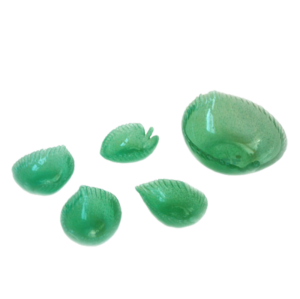
While architecture was Scarpa’s main focus, he was also very interested in glass making. During the 1920s, Scarpa created his first pieces while working for Cappelin. He later became the artistic director of Venini from 1933 to 1947. Venini was one of the most important Venetian glass makers during this time, and Scarpa’s natural understanding of raw  materials allowed him to flourish as artistic director. Scarpa sculpted with glass to create objets d’art and lamps, and brought a theatrical element to his designs. He was influenced by the environment, as well as the Orient, and applied these influences to his designs. He also invented a variety of techniques that became trademarks of Venini glass during the thirties and forties. These techniques include filigrana, velato, opalini, lattimi, murrine, sommersi, and battutto.
Many of the techniques that he pioneered were very difficult technically, which is one of the reasons that they command high prices. Working with glass of different colors is difficult, as each color has its own co-efficient of expansion, and reacts to heat differently. The battutto, in which the surface is hand-worked to create a “hammered” texture, was difficult, as the pattern had to be carefully controlled, and the pressure could easily cause a piece to break. This was an important technique that Scarpa pioneered in 1940. Filigrana, another important technique, involves spiraling very thin strands of glass onto an already blown form – the strands had to be perfectly spaced.
The murrine technique is a very ancient one, and involved first forming the “murrines” -rods containing different colors of glass in specific colors into a specific pattern, which could be flowers, faces, or the abstract geometric motifs that Scarpa favored. These rods were then cut into thin sections. Melding these slices seamlessly was challenging, as was forming the actual piece. The extreme thinness of his pieces made the work even more difficult technically. Usually, the finished pieces were given a very fine battutto finish. This process of blowing glass to extreme thinness was called soffiati. His murrine pieces are, perhaps, his most important achievement. When translucent glass was used, the effect is like a stained-glass window. When opaque glass, sometimes referred to as pasta vitreo was used, the resulting pieces look as if carved from some kind of magical wood.
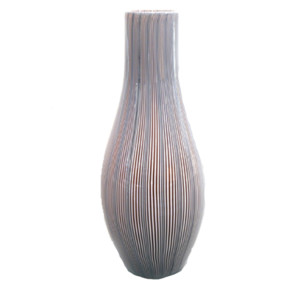
Another important and difficult technique used by Scarpa was tessuto, in which very thin canes of glass of different colors were fused, and then the vase was blown very thin. The rods had to form perfect vertical lines – any pieces that were not perfect were discarded. Sometimes, the surface was left shiny, and for some pieces, it was subjected to battutto for added texture, and a matte finish.
 Another important style of glass introduced by Scarpa was the corroso series. These pieces were of very thick and heavy glass, known as pesanti, in which various knobs, swirls and other elements of form were pulled directly from the hot glass, and then the piece was treated with acid to give it a “corroded” finish. A similar technique was used for the sommerso vases, which differed from the corroso by having two layers of differently colored glass.
Scarpa also designed glass with very simple forms, known as Cinese, as they were influenced by the shapes of Chinese ceramics. These pieces were richly colored, and had a shiny finish, almost like glazed ceramic. Occasionally, he would give these pieces a very fine battutto finish, resulting in a velvety surface known as velato.
 After Scarpa left his position as artistic director of Venini, he began his career as an architect. Beginning with his design of a Paul Klee exhibition in 1948, Scarpa became associated with the Venice Biennale. Scarpa’s unique ability to transform spaces made him a master of exhibition design. He had an instinctive understanding of works of art, and used innovative materials, lighting effects, and chromatic relationships to create spaces that had never been constructed before.
Throughout all of his various projects, Scarpa never lost his passion for teaching. He continued to be a part of the faculty at Venice’s Istituto Universitario di Architettura, and from 1954 to 1964, he taught every year to Fulbright scholars in Rome.
Scarpa’s won many awards for his work and his many achievements. One of the awards he was given was the National Olivetti Award for Architecture, which he won in 1956. Also in 1956, Scarpa designed a series of glass for I.V.R Mazzega. He was also awarded with the IN-ARCH National Award for Architecture for the Castelvecchio Museum of Verona, in 1962, for his accomplishments in the field of architecture.
Carlo Scarpa died in 1978 in an unfortunate accident while visiting Japan. His son, Tobia, continued to design and make very interesting glass. Carlo Scarpa will always be remembered as one of the most important architects and glass makers of the Twentieth Century, and his innovative techniques still influence the work of artists today.
Showing all 2 results